 Fluentd
udp
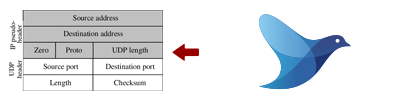
The in_udp Input plugin enables Fluentd to accept UDP payload.
It is included in Fluentd's core.
Example Configuration
<source>
  @type udp
  tag mytag # required
  <parse>
    @type regexp
    expression /^(?<field1>\d+):(?<field2>\w+)$/
  </parse>
  port 20001               # optional. 5160 by default
  bind 0.0.0.0             # optional. 0.0.0.0 by default
  message_length_limit 1MB # optional. 4096 bytes by default
</source>
Refer to the Configuration File article for the basic structure and syntax of the configuration file.
For <parse>, refer to Parse Section.
We have observed drastic performance improvements on Linux, with proper kernel parameter settings (e.g. net.core.rmem_max parameter). If you have high-volume UDP traffic, please make sure to follow Before Installing Fluentd instructions.
Plugin Helpers
Parameters
See Common Parameters.
@type
The value must be udp.
tag
| type | default | version |
|---|---|---|
| string | required parameter | 0.14.0 |
The tag of the output events.
port
| type | default | version |
|---|---|---|
| integer | 5160 | 0.14.0 |
The port to listen to. (default: 5160)
bind
| type | default | version |
|---|---|---|
| string | 0.0.0.0 (all addresses) | 0.14.0 |
The bind address to listen to.
source_hostname_key
| type | default | version |
|---|---|---|
| string | nil (no adding hostname) | 0.14.10 |
The field name of the client's hostname. If it is set, the client's hostname will be set to its key.
If you set the following configuration:
source_hostname_key client_host
then the client's hostname is set to client_host field i.e.:
{
    ...
    "foo": "bar",
    "client_host": "client.hostname.org"
}
source_address_key
| type | default | version |
|---|---|---|
| string | nil (no adding source address) | 1.4.2 |
The field name for the client's IP address. If you set this option, Fluentd automatically adds the remote address to each data record.
For example, if you have the following configuration:
<source>
  @type udp
  source_address_key client_addr
  # ...
</source>
You will get something like this:
{
    ...
    "client_addr": "192.168.10.10"
    ...
}
source_host_key
| type | default | version |
|---|---|---|
| string | nil | 0.10.51 |
This parameter is deprecated. Use source_hostname_key instead.
The field name of the client's hostname.
message_length_limit
| type | default | version |
|---|---|---|
| size | 4096 | 0.14.14 |
The maximum number of bytes for the message.
body_size_limit
| type | default | version |
|---|---|---|
| size | nil | 0.10.51 |
This parameter is deprecated. Use message_length_limit instead.
The maximum number of bytes for the message.
remove_newline
| type | default | version |
|---|---|---|
| bool | true | 0.14.23 |
Removes the newline from the end of the incoming payload.
receive_buffer_size
| type | default | version |
|---|---|---|
| size | nil | 1.0.1 |
This is a deprecated parameter. Use receive_buffer_size in <transport> section instead.
The max size of socket receive buffer. This is used in SO_RCVBUF socket option.
<transport> Section
| type | default | available values | version |
|---|---|---|---|
| enum | udp | udp | 1.18.0 |
This section is for some general transport configurations. See Config: Transport Section for all supported parameters.
<parse> Section
| required | multi | version |
|---|---|---|
| true | false | 0.14.10 |
in_udp uses the parser plugin to parse the payload.
For more details:
Code Example
Here is a Ruby example to send an event to in_udp:
require 'socket'

us = UDPSocket.open
sa = Socket.pack_sockaddr_in(5160, '127.0.0.1')

# This example uses json payload.
# In in_udp configuration, need to configure "@type json" in "<parse>"
us.send('{"k":"v1"}', 0, sa)
us.send('{"k":"v2"}', 0, sa)
us.close
FAQ
How to prevent request drop?
If in_udp gets lots of packets within 1 sec, some packets are dropped. For example, you can see bigger RcvbufErrors number via netstat -su.
This means that in_udp with one process cannot handle such traffic loads. Try multi workers.
How to receive binary data that contains newline bytes
If you are trying to receive binary data containing '\r' (0x0d) or '\n' (0x0a), you need to tweak remove_newline to prevent Fluentd from corrupting payloads.
For example, suppose you intend to receive packets which contain the following data:
\xa9test\ntest (0xa9, 0x74, 0x65, 0x73, 0x74, 0xa, 0x74, 0x65, 0x73, 0x74)
you need to be careful that the default behaviour of Fluentd is to trim the 6th byte (0x0a) from payload. If you do not want this behaviour, please configure remove_newline to false.